Designing Internal Systems with Filament in Regulated Environments

Gerald Warri

In regulated financial environments, internal software isn’t just operational.
It’s evidence.
Every request, approval, onboarding decision, and override must be traceable.
Not because it’s convenient — but because it’s required.
Over the past few years, we’ve built multiple internal systems for a financial services firm operating under regulatory oversight — including:
Requisition workflows
Petty cash management
Inventory tracking
Vendor oversight
Customer account opening
Here are the architectural lessons that mattered most.
1. Role Isolation Is Architecture, Not Configuration
In regulated environments:
Initiators cannot approve their own requests
Department heads see only their teams
Finance sees cross-department flows
Executives see summaries, not raw operational detail
This behaves like multi-tenancy inside a single organization.
We designed policies first — not later.
Every resource had explicit access rules from day one.
That decision prevented months of retrofitting.
2. Approval Chains Must Be Enforced, Not Suggested
Email confirmations and Slack approvals don’t survive audits.
Every workflow followed enforced state transitions:
Draft → Submitted → Department Review → Finance Review → Final Approval → ExecutedNo skipping.
No silent overrides.
Every transition logged.
That enforcement layer is what made the system defensible.
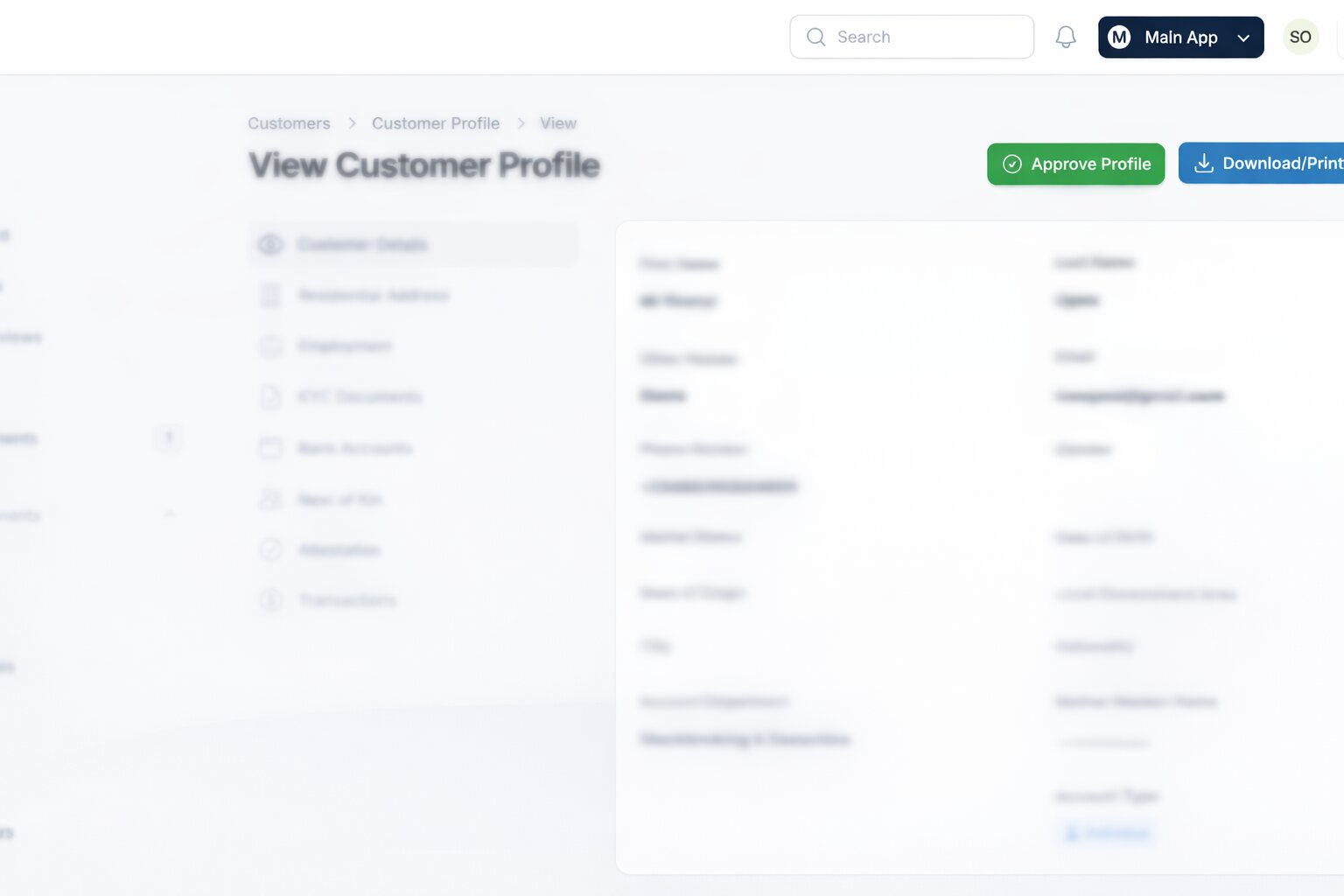
3. Customer Account Opening Is a Workflow — Not a Form
Customer onboarding required:
Structured multi-step data capture
Mandatory document uploads
Compliance review queues
Risk checks
Approval escalation
This wasn’t a “signup page.”
It was a controlled onboarding pipeline.
Each stage was:
Role-bound
Timestamped
Logged
Reviewable
The same architectural discipline used in internal finance flows applied to customer onboarding.
4. Audit Trails Are Insurance
In financial systems, the question is not:
“Did it work?”
It’s:
“Can we reconstruct exactly what happened?”
We logged:
User ID
State transitions
Timestamps
Contextual metadata
Auditability wasn’t a feature — it was protection.
5. Modular Systems Prevent Entropy
Instead of building one massive “Operations Portal,” we separated modules:
Requisition
Inventory
Petty Cash
Vendor Management
Customer Onboarding
Each module had independent workflows, but shared:
Authentication
Policy architecture
Logging standards
Notification patterns
This kept complexity manageable as the system grew.

What We’d Do Differently
Design dynamic approval routing earlier
Optimize dashboard queries sooner
Simplify UI from day one
Internal users value clarity over sophistication.
When Filament Works Well in Regulated Environments
Filament works best when:
You need enforced workflows
You require traceability
You want long-term ownership
You already operate in Laravel
It’s less ideal when the workflow is generic and already solved well by SaaS.
Final Thought
In regulated financial environments, software becomes institutional memory.
Built correctly, it doesn’t just process transactions.
It protects the organization.
Share this article

Related Articles

Embedding Livewire Components in Filament 4 Schemas
How Filament 4 makes it easier to build flexible, reusable interfaces with Livewire

Adding a Kanban Board per Resource in Filament PHP
Learn how to create a dynamic Kanban board per resource in Filament PHP. Perfect for managing proposals visually in your projects.

15+ Top Open Source Filament PHP Projects
Learn from the best with our curated list of open-source Filament PHP projects, perfect for customization or inspiration